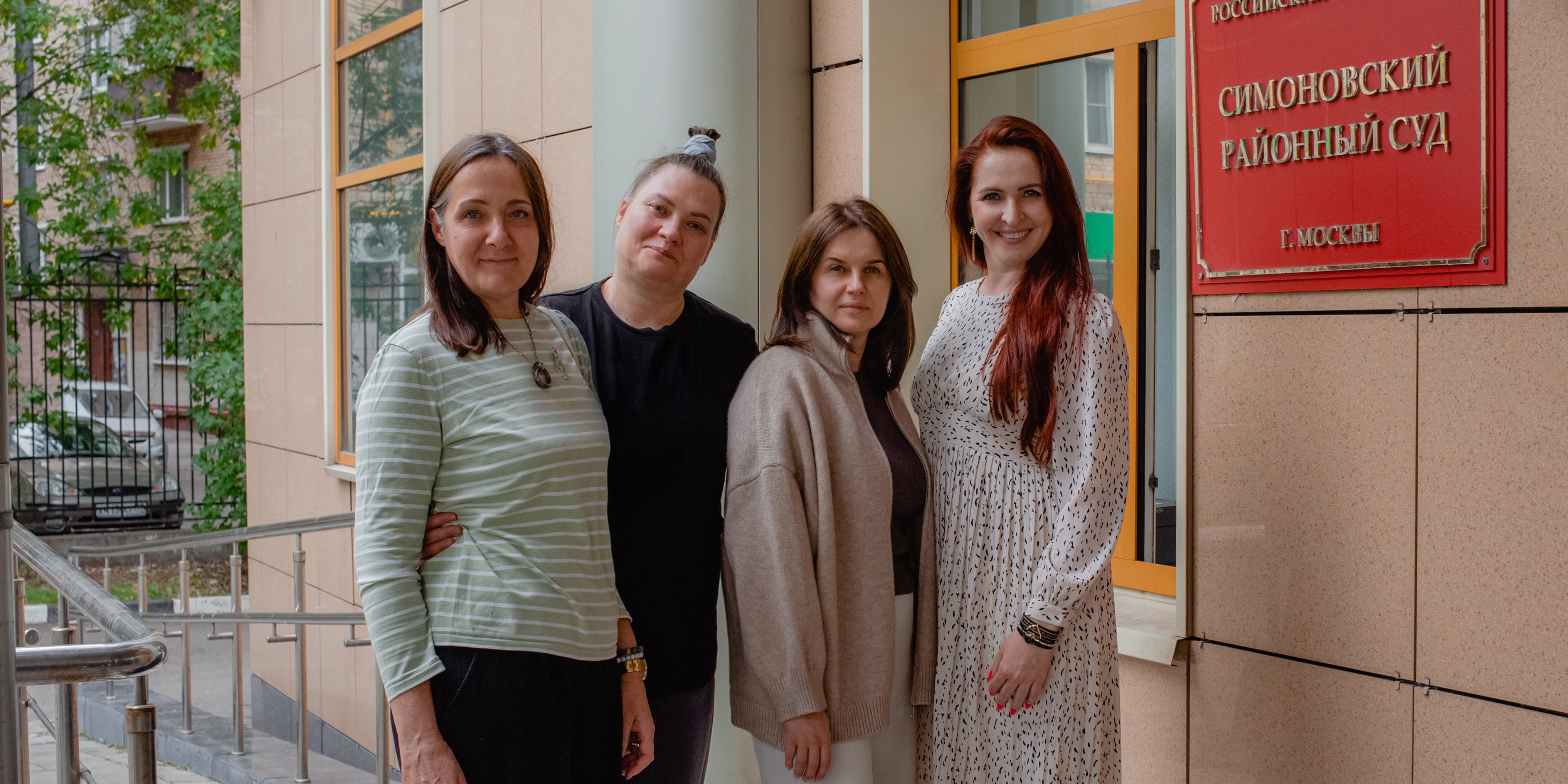
Oksana Ivanova, Liliana Korol, Larisa Kislaya and Tatyana Levitskaya at the courthouse on the day of the verdict. August 2026
Oksana Ivanova, Liliana Korol, Larisa Kislaya and Tatyana Levitskaya at the courthouse on the day of the verdict. August 2026
In Moscow, Jehovah's Witnesses Convicted for Card Saying "There Is Hope" and for Bible Discussions. Two Are Sent to Penal Colony, Four — to Forced Labor
MoscowOn August 26, 2026, the Simonovskiy District Court of Moscow announced the verdict against six local Jehovah's Witnesses: Zaur Murtuzov and Darya Petrochenko — 5 years in a penal colony; Liliana Korol, Larisa Kislaya, and Oksana Ivanova — 4 years forced labor; and Tatyana Levitskaya — 3 years and 8 months forced labor.
The believers were found guilty of participating in the activity of an extremist organization and involving others in it. That was how the investigation interpreted conversations about the Bible with a woman who called herself Olga Grigoryeva. At the cemetery she found a handmade comforting card with the words "There Is Hope" and Petrochenko's contact information. As Grigoryeva later stated in court, at that moment she was struggling with the loss of a loved one, and Darya supported her. After that, they continued to communicate for another two years, and Grigoryeva recorded these conversations.
During the preliminary investigation, this witness for the prosecution appeared under a different surname — Gromykina. The defense noted that the passport in the name of Grigoryeva was issued to her long before she met Darya, which may indicate prior preparation for a provocation. The witness explained that she contacted the FSB because of the name Jehovah. When Darya asked whether this name was prohibited, the woman could not answer.
"I know my motives. I really wanted to support a person who supposedly lost a loved one. I did not ask her for anything, I did not offer her anything... I did not cause her any harm nor to the constitutional order," Darya said in her final statement. "Despite this incident, I have not lost the ability to trust people and do not see everyone as an enemy."
Those convicted are ordinary people with peaceful professions. Zaur Murtuzov, 49, a graduate of Bauman Moscow State Technical University, worked in warehouse logistics; Darya Petrochenko, 34, a lawyer and translator, was the chief specialist at the Ingushetia Representative Office to the President of Russia in Moscow; Larisa Kislaya, 50, provided cleaning services; Oksana Ivanova, 56, is a pediatrician and psychologist; Liliana Korol, 48, is a cosmetologist; Tatyana Levitskaya, 43, is a personal travel agent.
In December 2024, officers of the Investigative Committee and the FSB, supported by the National Guard and SWAT, conducted searches in Moscow and the nearby town of Lyubertsy. According to eyewitnesses, in some apartments law enforcement officers broke down doors with crowbars and sledgehammers; Murtuzov was struck on the head and abdomen and his nose was injured.
Darya, Liliana, and Zaur were held in a pretrial detention center for more than 1.5 years. For most of this time, Darya was not allowed visits or phone calls. Liliana has severe chronic illnesses, including diabetes. In January 2026, she was hospitalized in an emergency. The other defendants remained under house arrest during the investigation. The court proceedings, led by Dmitriy Merzlyakov, began in January 2026.
Despite prolonged isolation and other difficulties, the believers do not give up. "I focus on how I can benefit myself and others," noted Tatyana Levitskaya. Friends and loved ones tried to support the believers during the trial. "One friend, at the end of every letter, assured me: 'Always remember that 9 million are praying for you,'" said Liliana Korol. "This always served as powerful support." Larisa Kislaya said: "I knew I had friends, but only now I fully understand how important I am to them and how many there really are." On the day the verdict was announced, about 120 people came to support the believers.
As of today, in Moscow and the Moscow Region, more than 30 Jehovah's Witnesses have become defendants in criminal cases for their faith; 9 of them are serving terms in penal colonies.


